P.O. Box 1163
Lemont, PA 16851
(814) 883-7799
damaple@comcast.net | | 


I have made a number of different clavichord models over five decades. These listed here are among my
favorites. I am also happy to discuss earlier instruments,
both triple- and double-fretted, as well as other larger unfretted models after the Saxon or Hamburg instruments.
Custom instruments built to the buyer's specifications require a commission, but finished standard instruments may occasionally be offered for direct purchase. Please check Clavichords for Sale for instruments that may be available.
Click on the images below for enlarged versions.

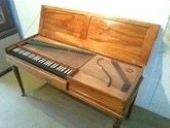
17th-century fretted clavichord
This double-fretted clavichord is based on an anonymous instrument in the Musical Instrument Museum in Leipzig. The compass is C/E-c3, which was standard for most of the 17th century. The antique has the common C/E short octave configuration in the bass, with no split sharps. Due to the generous spacing of the strings on the bridge, however, is was a simple matter to add one course of strings
and to rearrange the key levers so that split sharps could be added. This provides the low F# and G# that were increasingly required towards the end of the century.
The soundboard and bridge are longer than usual for 17th-century instruments, and the bridge is also taller and more massive. As a result, the instrument has a more sonorous and sustaining sound, compared to some contemporary instruments that have a more rapid decay. The string scaling is short and appropriate for tuning to the common tone-high pitch known as Chorton in the late Baroque.
Specification:
C/E-c3, short octave, A-466. Case of varnished hardwood, or
pine with a painted finish (as in the original). 114 x 33 cm
(45 x 13 in).
18th-century fretted clavichord
The compass of this anonymous double-fretted instrument from the Metropolitan Museum of Art in New York extends to e3, which probably dates it
from the middle third of the 18th century. It is still relatively small and
easily portable, however. The instrument's sound also is similar to small, earlier instruments, with a sweet treble and a gentle, lute-like bass.
The treble compass can be extended to f3if desired. With its chromatic bass to C, the instrument is capable of playing a wide range of pieces, subject to the restrictions of the fretting system.
Specification:
C-e3, chromatic, A-415. Case of varnished hardwood, or
pine with a painted finish (as in the original). 114 x 36 cm
(45 x 14 in).
Unfretted clavichord after Specken
Philip Jacob Specken apprenticed with the great organ and stringed-keyboard maker Gottfried Silbermann in Freiberg, Saxony, and then
relocated to Stockholm in the 1730s. He was initially employed there by several other masters, but by 1737 he was signing instruments with
his own name. In the 1740s he produced a series of clavichords that were similar in some aspects to the
Saxon design used by Friederici and other later Silbermann apprentices. Both fretted and unfretted instruments were made in his shop,
mostly with the range of C-d3;
by around 1748 Specken sometimes extended the upper compass to include e3.
Due to the relatively long length of the bridge in the bass, no over-wound strings are required. The sound of the bass is full, but noticeably distinct in timbre from that produced by over-wound strings. The tuning pins are set further to the right, compared to the Friederici and Horn instruments, and the long string segments between the bridge and tuning pins resonate freely with the main sounding lengths. The resultant overall sound has a nice singing quality, with good sustain. With its mid-century compass and lineage to Silbermann's clavichords, Specken's model is especially appropriate for the music of J. S. Bach, his sons, and their contemporaries.
Specification:
C-e3, chromatic, A-410. Case of varnished hardwood or painted pine. Ebony or plum naturals
and bone-capped accidentals. Four screw-on legs are included in the base
price. 151 x 46 cm (59 x 18 in).
Unfretted clavichord, adapted from J. H. Silbermann
Another maker who apprenticed with the elder Silbermann was his nephew, Johann Heinrich Silbermann, who later returned to his native Strasbourg. There he worked with his brother, Johann Andreas, producing organs and a wide variety of stringed keyboards. Johann Heinrich is now often associated with a particular clavichord model that is surprisingly compact for a five-octave instrument from the 1770s. As can be seen in the photo of one of the antique examples (Berlin, Museum of Musical Instruments), this design retains a number of features associated with instruments from the earlier part of century, including a smaller case size (length = 137 cm, 54 inches), and a shorter, S-shaped bridge located centrally on a modest soundboard that is roughly square in shape.
In the bass, the use of the wound-string technology developed in the later part of the 18th century makes it possible for the relatively short bass strings to function remarkably well, although with less depth and power when compared to the larger instruments from contemporary Saxon makers such as Friederici and Horn. Overall, the clarity and balance of sound and the responsive touch of this compact Silbermann design make it a versatile instrument for modern players who wish to play a broad range of 18th-century music.
Johann Heinrich also made some larger clavichords, however, and one such surviving instrument is also preserved in the Museum of Musical Instruments in Berlin. The case of this instrument is 155 cm (61 inches) long, somewhat deeper, and with a soundboard compartment that is significantly enlarged — allowing a more graceful extension of the bridge in the bass. These changes contribute to a fuller bass sound. This nominal '5-foot' case length was actually quite common in clavichords from various makers in the second half of the century, perhaps for the practical reason that it reduces the wide arm stretch necessary while tuning the lower bass notes, compared to the very long, late instruments built in Saxony and Hamburg.
I have recently built a number of examples of a very successful intermediate-sized clavichord inspired by the two Silbermann models, as shown here. These instruments are 148 cm (58 inches) in length, yet they retain the exact layout of the key levers, bridge, and soundboard from the compact model in the treble and mid-range, along with its shallower case depth. The base level for this model has a simple flat-panel lid, but the attractive paneled lid seen in the antiques is available as an option.
I am also happy to build either the compact model or the larger 155 cm model, if requested.
Specification:
FF-f 3, chromatic, A-415 (A-440 version is also possible). Case of walnut. Ebony naturals
and bone-capped accidentals. Four screw-on, square-tapered legs are included in the base
price. Other case woods, a paneled lid, a soundboard rose, and alternate leg styles are
available as options. 148 x 49 cm (58 x 19 in).
|